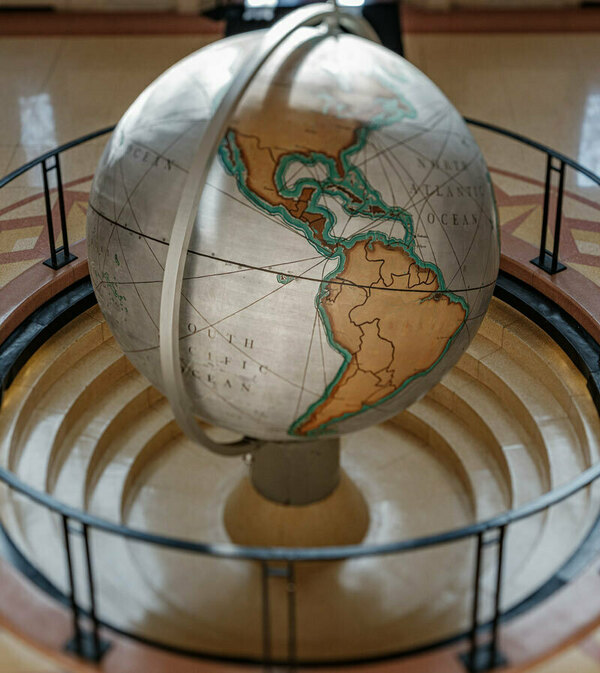
Catholicism is the world’s most global, multicultural, and multilingual institution, and Notre Dame must better embody that reality in the coming decade. The Church now includes 1.3 billion baptized members; the modal Catholic is a person of color living south of the equator. Anyone working at Notre Dame sees this reality. The Congregation of Holy Cross includes schools and parishes in sub-Saharan Africa, Latin America, and South Asia, some of which have given Notre Dame footholds for research and service in those regions. The Department of Theology trains seminarians from Ukraine, Nigeria, and China; the Cushwa Center for the Study of American Catholicism sponsors work on global Catholic history; the Keough School of Global Affairs partners with Catholic Relief Services; and the Institute for Educational Initiatives works with local dioceses on education in Haiti. The Kroc Institute for International Peace Studies helped broker a peace agreement in war-torn Colombia that earned a mention in a Nobel Peace Prize acceptance speech. 22 Some of the University’s deepest institutional partnerships are with Catholic universities in not only Europe, particularly eastern Europe, but also Latin America and sub-Saharan Africa. Leveraging these networks is a route to both excellence and distinctiveness.
Global strategy.
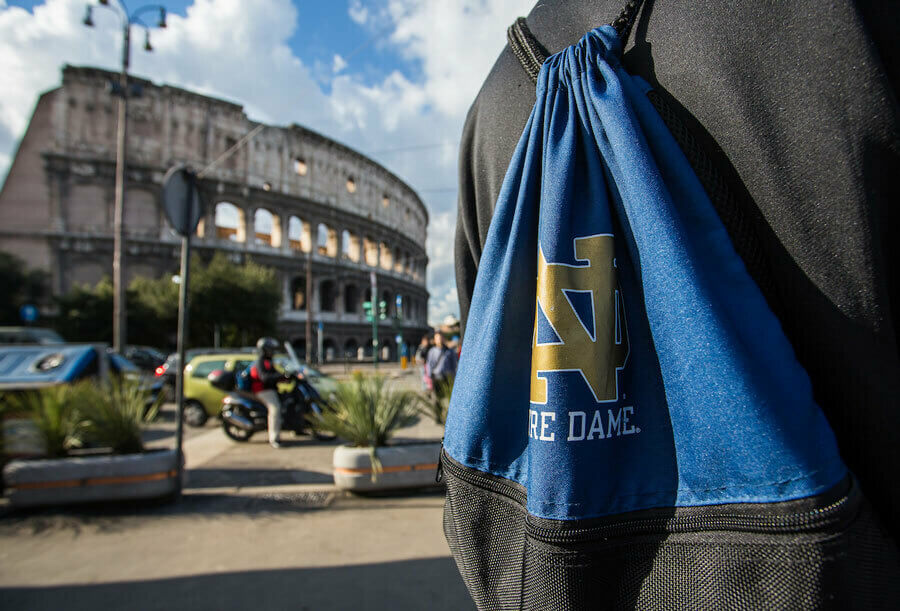
Considerable strides have been taken in recent decades toward making Notre Dame a more global institution. The University has long welcomed scholars from outside the United States — including an especially distinguished group that fled Europe just before World War II — and the Catholic mission has given faculty and administrators horizons beyond the nation-state. The Law School began its program in London in 1968. Architecture required all of its students to spend a year studying in Rome beginning in 1969.
The effort to become more global — potentially as important for the next generation at Notre Dame as the effort to develop research was in the last — will in some ways proceed organically. Ambitious faculty will establish research partnerships with colleagues across the world and in so doing shape the education our students receive. At the same time it is necessary to develop a global strategy — and funding model — integrated into the overall plan of the University, not as a set of auxiliary enterprises.
The most significant recent developments were the founding of Notre Dame International (2010) as a division of the University charged with supporting and coordinating our international efforts and the founding of the Keough School of Global Affairs (2014). The Keough School is dedicated to multidisciplinary research on integral human development, a term drawn from Catholic social thought. It includes a master’s program, an undergraduate major, and joint doctoral programs with departments in the humanities and social sciences. Constituent elements of the school included multiple centers and institutes testifying to Notre Dame’s global ambitions. 23 The Mendoza College of Business sponsors global experiential learning opportunities including its Meyer Business on the Frontlines program; the Law School has recently rearticulated its vision of a global lawyer. Research efforts in many areas, from anthropology to civil and environmental engineering to global health, involve fieldwork, service-learning, teaching, and collaboration with scholars and students outside the United States.
Facility expansion was notable. Since the late 1960s, the Vatican has allowed the University to use a significant property in Jerusalem near the Old City. Between 1998 and 2014 the University purchased and renovated marquee properties in London, Dublin, and Rome and rented a modest office in Beijing. Staff and faculty located at these sites — and around the world, including in Hong Kong, Santiago, Mexico City, São Paulo, Mumbai, and Kylemore Abbey (on the west coast of Ireland) — aided in the management of study abroad programs and facilitated faculty and student research. The Rome facility, for example, has become not only a second home for Architecture but a venue for a number of other campus entities to regularly convene academic events, develop research programs (with ties to the American Academy in Rome, the Vatican, and international Catholic agencies), and establish meaningful partnerships with Italian scholars and universities.
Challenges remain. That 77 percent of Notre Dame undergraduate students have studied outside the United States is a wonderful achievement. The percentage is one of the very highest in the nation for institutions of our size. Still, deeper integration of those students into host cultures through internships, language learning, and rigorous coursework will better prepare them to be global citizens. Notre Dame’s global sites have facilitated many research and educational successes, but campus units with global aspirations will need to become more intentional about supporting programming at these facilities. The absence of a major facility in the Global South is notable. The University possesses ties with many institutions outside the United States and the next step will be to develop a cluster of longer-term, more comprehensive partnerships rather than adding superficial agreements.
International students.
One tactic to build a more global, and Catholic, and diverse Notre Dame is to make the undergraduate student body more international. Among AAU private universities, the average percentage of international undergraduates is 12.2; Notre Dame’s percentage is 7. 24Deepening the pool of qualified international undergraduates will require more admissions outreach. A more dramatic (and expensive) step would be to consider need-blind admissions for international undergraduates. Such a policy would place Notre Dame in distinguished company — only seven colleges and universities in the United States make this claim — and would expand the global Catholic community on campus.
The situation for graduate and professional students is somewhat different. Impressively, graduate and professional students come from around the globe, with more than 1,000 students representing over 100 countries. Only 90 students are enrolled in the Keough School master’s program in global affairs, but they arrive at Notre Dame from 39 different countries.
Raising Notre Dame’s standing in international rankings will help us recruit even stronger students from outside the United States, especially in science and engineering. (The reverse is also true: significant percentages of international students assist us in international rankings.) So too will building conscious pipelines from particular regions and institutions, where talented undergraduates from outside the United States can learn about the quality of the graduate programs on offer at Notre Dame. Here, again, we test Notre Dame’s capacity to think as an institution. We should mobilize our supporters around the world to help us recruit the students (at all levels) our University needs.
Poverty.
Notre Dame’s mission statement calls us to cultivate in our students “a disciplined sensibility to the poverty, injustice, and oppression that burden the lives of so many.” 25 The mission statement itself reflects the Catholic commitment since the Second Vatican Council to what is frequently termed a “preferential option for the poor.”
How do we make this commitment more meaningful? Many building blocks exist. The Pulte Institute for Global Development, located within the Keough School, and the Building Inclusive Growth (BIG) Lab within the economics department are both focused on development issues in the Global South. The Wilson Sheehan Lab for Economic Opportunities (LEO), in the economics department, assesses antipoverty programs within the United States. All of these efforts leverage distinctive Catholic networks to build enduring partnerships, and move from fundamental research to policy recommendations. All provide superb research opportunities for graduate and undergraduate students.
The challenge in the next decade will be to identify opportunities for collaboration between these units and other areas where Notre Dame can deepen its intellectual capacity to study poverty. The overarching goal is bold: to make Notre Dame one of the best places in the world to understand the seemingly intractable problems of poverty, and in so doing offer routes out of poverty for those trapped within its confines.
Global Catholicism as a research and collaborative opportunity.
One revelation of the theme advisory committee process was the sheer number of organizations at Notre Dame focused on the history, current status, and future of Catholicism and other global religions.26 Projects in Catholic education, ecumenical and interreligious dialogue, social justice, the history of Catholicism, the contemporary pastoral life of the Church, sacred music, bioethical issues, and much else thrive at Notre Dame. Too often they do so on separate paths. Here, too, collaboration is an opportunity, even an imperative.
To that end, Notre Dame should launch a multifaceted effort to establish itself as a world leader in sponsoring research on the global Church and in fostering sustained reflection on the possibilities that Catholic beliefs and perspectives offer in response to contemporary challenges. Over the long haul, this commitment will shape the way we teach, the relationship between theology and other disciplines, and our institutional connections in the Global South.
Footnotes
22. ^ Juan Manuel Santos, “Peace in Colombia: From the Impossible to the Possible,” Nobel Peace Prize lecture of December 10, 2016, https://www.nobelprize.org/prizes/peace/2016/santos/lecture.
23. ^ The Ansari Institute for Global Engagement with Religion, the Kellogg Institute for International Studies, the Keough-Naughton Institute for Irish Studies, the Klau Institute for Civil and Human Rights, the Kroc Institute for International Peace Studies, the Liu Institute for Asia and Asian Studies, the McKenna Center for Human Development and Global Business, the Nanovic Institute for European Studies, and the Pulte Institute for Global Development.
24. ^ U.S. Department of Education, Institute of Education Sciences, National Center for Education Statistics.
26. ^ An incomplete list might include the Department of Theology, Cushwa Center for the Study of American Catholicism, Center for Social Concerns, McGrath Institute for Church Life, de Nicola Center for Ethics and Culture, Institute for Educational Initiatives, Nanovic Institute for European Studies, Medieval Institute, Sacred Music at Notre Dame, Ansari Institute for Global Engagement with Religion, Center for the Philosophy of Religion, Tantur Ecumenical Institute, and Devers Family Program in Dante Studies.