How do the arts make us look more deliberately?
How does music let us listen more closely?
How might literature enable us to read more carefully?
How might dance help us feel more strongly?
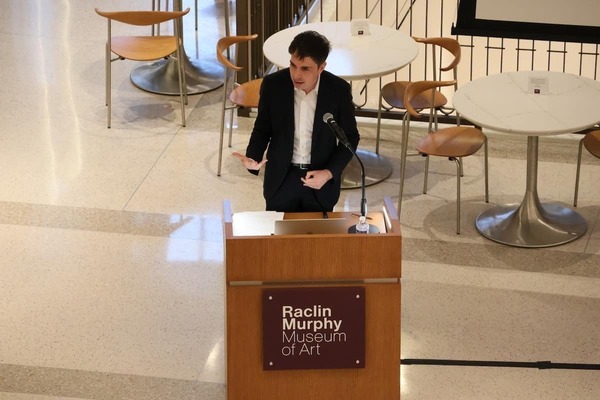
These are just some of the questions that New York Times art and culture critic Jason Farago explored during his recent visit to Notre Dame on February 24, 2026. The Franco Family Institute for Liberal Arts and the Public Good, the Raclin Murphy Museum of Art, and the Arts Initiative at the University of Notre Dame partnered together to host Farago and hear his thoughts on the current state of the arts and criticism in our moment of divided attention and waning attention spans.
Connecting Students and Professionals
Farago’s visit began with an undergraduate student luncheon co-organized by the Arts Initiative and Beyond the Dome, the College of Arts and Letters' career development program.

The group held an energetic and wide-ranging conversation about Farago’s career path, the role of the critic in society, Emerald Fennel’s new Wuthering Heights adaptation, the value of a liberal arts education, art in the age of AI, and writing in the age of Large Language Models (LLMs).
Farago encouraged students to maintain curiosity about the future while cultivating focus through their studies at Notre Dame. After joking that he "became a journalist by accident" (Farago studied art history, not journalism, at Yale University and the Courtauld Institute of Art), Farago insisted that the skills he gained studying art history set him up for success in a career he had not initially anticipated.
"One of the Arts Initiative's priorities is to cultivate generations of Notre Dame students who see themselves as cultural leaders, not simply cultural consumers, no matter their professional path," says Arts Initiative managing director Rebecca Struch. "Connecting students to successful working professionals like Farago provides them with real-life examples of how to build that somewhat elusive thing known as a 'career' while encouraging them to connect their studies to contemporary conversations about arts and culture they will help shape after graduation. We are immensely grateful to Farago for engaging with our students in such a memorable way."
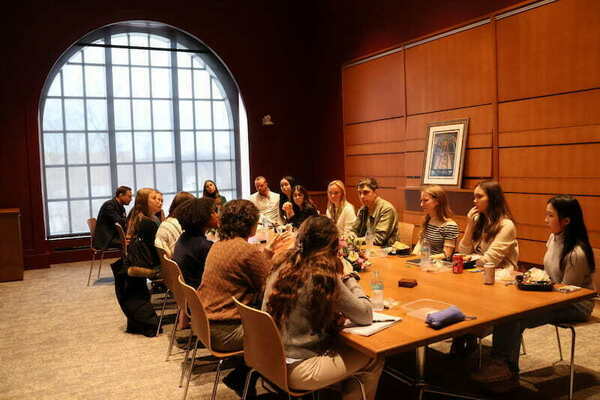
"There is no better way for our students to gain greater career clarity than to meet with professionals in the industry. Farago’s visit offered us the perfect opportunity to partner with the Arts Initiative to deliver such a high-impact experience for our students,” says Jared Mrozinske, Beyond the Dome’s director. “As our two units grow, we hope to provide even more opportunities like this one so that our students can see firsthand how the foundational skillset they are building in the College of Arts & Letters translates directly to successful careers in the industry."
The Work of Art in the Age of Mechanical Distraction
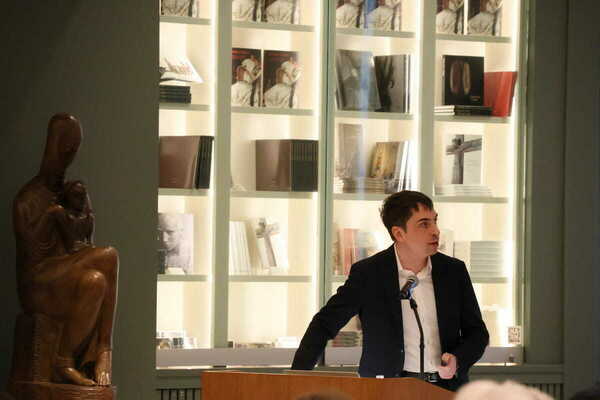
Following the student luncheon and an afternoon touring the School of Architecture and the Raclin Murphy Museum of Art, Jason delivered a lecture titled “The Work of Art in the Age of Mechanical Distraction” in the art museum’s atrium to a crowd of approximately 200 attendees.
The Franco Institute initially invited Farago to campus for this event to tie into the institute's annual research theme of "Attention." In the lecture, Farago spoke about how contemporary artists have responded to technology and how it affects how we encounter art. He offered positive prescriptions for creators and viewers alike. He shared readings and interpretations of various artworks, with special emphasis on Sun & Sea (Marina), the 2019 Golden Lion-winning immersive opera by Lithuanian creators Rugilė Barzdžiukaitė, Vaiva Grainytė, and Lina Lapelytė.
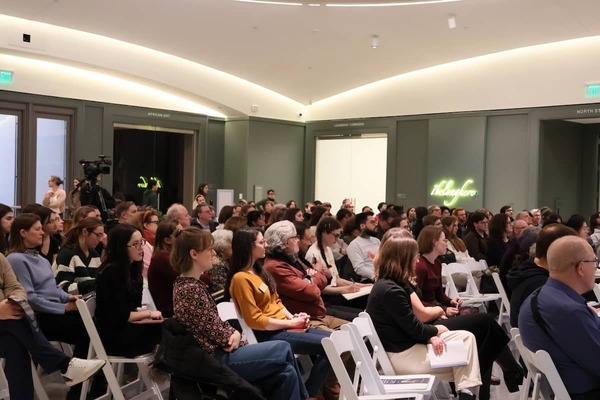
The Raclin Murphy student guides attended Farago's lecture alongside the general audience. Olivia Schmitt, one of the student guides, was present at both the student luncheon and the evening lecture. "It was exciting to hear from someone who has so successfully integrated a passion for art and the liberal arts into a journalism career," Schmitt said. "I particularly enjoyed hearing Mr. Farago's thoughts on what 'impact' and 'success' mean for art museums in an era dominated by distracting devices—and I was thrilled to learn that he, too, was once a student guide at his university museum as an undergraduate!"
Kate Marshall, Director of the Franco Institute, situated the relevance and insights that Farago brought to ongoing campus conversations. "Farago's lecture highlighted so many aspects of the conversations we've been having across the College this year on the topic of attention but with a powerful sense of how these questions are especially urgent for thinking about contemporary art and our encounters with it,” she said. “Jason Farago made a compelling case for the importance of attention to attention."
Jason Farago is a critic at large for The New York Times, writing about culture and its place in the wider world. He is an art critic and columnist who regularly contributes to The Guardian, The New Yorker, and The New Republic. In 2023, he was a finalist for the Pulitzer Prize for criticism.
Originally published by at franco.nd.edu on March 26, 2026.